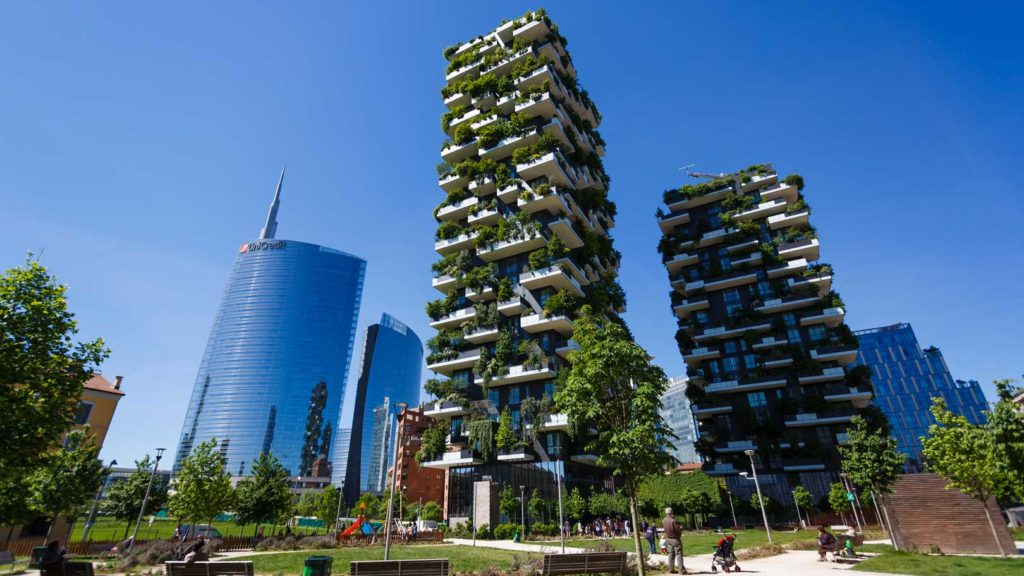
Both Japan and the European Union set the goal to reach carbon-neutrality by 2050, requiring a balance between emitting and absorbing carbon, for which greenery, as natural carbon sink is essential. Project GreenQual aims to improve Urban Green Surfaces (UGS) and investigate their effects in multiple urban fabric types and climate zones to support carbon-neutral cities. The role of UGS includes improving urban water, soil, and air quality, decreasing Urban Heat Island effect, flash floods, and drought occurrences, thus becoming increasingly important for sustainable habitat, climate change adaptability and resilience. The complex effect of greenery in densely built settlements at the same time provides an overall better environment, physical and mental health by reducing exposure of citizens.
During the three years of the project, researchers from Osaka, Krakow and Budapest join their forces to address the above factors with various research methods including cooperative design, workshops, and knowledge transfer. To find optimal UGS solutions, three cities were chosen. In Japan, the focus of the study will be the urban area of Osaka city adjacent to Osaka Bay. In Hungary, the capital city Budapest and its tenement areas are aimed, the densely built turn-of the century area in flat Pest and hilly Buda, also the characteristic Socialist Modernist estates are in focus. In Poland, Krakow, the centre of Old Town and its parks and so-called green strips and big meadow are investigated.
To fulfil their roles, urban green areas must be accessible. Therefore, accessibility of greenery in the cities is monitored to support environmental justice in carbon neutral cities. A new method for determining UGS accessibility is tested and proposed to overcome the limitations of existing approaches. The accessibility is measured in large-scale, using city data sets, open data as well as satellite imagery. 2-3 case study blocks in every city are chosen to be modelled in 2D and 3D, their basic characteristics for example density, infrastructure and building geometry level measurements are collected. As next step, simulation, experiments, and calculation of the case study blocks carried out, using different methodologies based on the unique expertise of the partner institutions.
The results and methods are analysed and compared, their applicability to different city and climate zones is investigated via co-design workshop to ensure knowledge transfer between the partners, and the systematic and holistic focus for the final results. The research results, best practices and the sample green surfaces designed are summarised in a handbook and published, which can be utilised by all countries’ key stakeholders – municipalities, urban and architectural design offices, strategy making, and decision support professionals can gain information and designs for UGS to support a sustainable future.
Partners
POLAND – ACADEMIC PARTNER
University of Agriculture in Krakow
✩Quality Assurance Supervisor
The University of Agriculture in Krakow (UAK) is the Polish academic partner in GreenQual and leads WP1: Case study area analysis as well as T1.1 Large-scale area analysis. In the proposal, UAK is presented as a specialist university active in agriculture, forestry, environmental protection, and environmental engineering. Within the project, its role is to investigate the variety, coverage, distribution, and accessibility of urban green spaces across Osaka, Krakow, and Budapest, and to support the development of accessibility maps that identify areas requiring green-space improvement. UAK also contributes expertise in 2D and 3D spatial analysis of urban fabric, green walls, optimal land use, land abandonment, climate–soil relationships, soil chemistry, and the analysis of soils exposed to anthropogenic pressure. In addition, Barbara Czesak is assigned the consortium role of Quality Assurance Supervisor, and UAK hosts WS#1 – UGS Discussion in Krakow.
WP1 LeadCase Study AnalysisLarge-scale Area AnalysisUrban Green Accessibility2D & 3D Spatial AnalysisGreen Walls
RESEARCH TEAM
dr inż. Barbara Czesak
Researcher
Associate Professor at UAK and the main named Krakow partner in the consortium. Her research focuses on land-use change, urban green areas and their accessibility, spatial information systems, land management, and urbanisation. In GreenQual, she is particularly relevant to the project’s spatial-analysis and accessibility methodology, and she also serves as Quality Assurance Supervisor.
dr inż. Renata Różycka-Czas
Researcher
Associate Professor at UAK. Her expertise covers suburban development, local development, spatial information systems, urban green-area accessibility, and GIS tools. Her profile aligns with the project’s methodological work on green-space accessibility and spatial analysis in Krakow.
dr hab. inż. arch. Bogusław Podhalański, prof. URK
Researcher
Professor at the University of Agriculture in Krakow. His research focuses on architecture, revitalisation, gentrification versus structure relocation, historic-city research, pedestrian networks, spatial and urban design, and green walls. Within GreenQual, he contributes the architectural and urban-design perspective, particularly for historic urban fabric, green-wall implementation, and spatial design in dense city contexts.
dr inż. Dawid Kupka
Researcher
Research assistant at UAK’s Faculty of Forestry. His expertise covers forest biogeochemistry, forest soil science, warming–soil interaction, and climate-sustainable silviculture. His contribution to GreenQual is aligned with soil analysis and climate–soil change relationships.
prof. dr hab. inż. Józef Hernik
Researcher
Professor at the University of Agriculture in Krakow. His profile is centred on cultural landscapes, land use, environmental development, environmental policy, risk mitigation, and climate-change-related land management. In the context of GreenQual, his expertise is highly relevant to optimal land use, landscape governance, and the environmental management dimension of urban green-space planning.
prof. dr hab. inż. Piotr Gruba
Researcher
Professor of Forest Sciences, specializing in forest soil science and biogeochemistry. Author of over 80 scientific publications on soil ion exchange, soil pollution, and soil organic matter dynamics under changing climate conditions. His contribution to GreenQual is aligned with soil analysis and climate–soil change relationships.
HUNGARY – EUROPEAN LEAD
Óbuda University
✩Project Coordinator
Óbuda University is one of the core academic partners of the GreenQual project and the
European lead institution of the consortium, with Dr. Viktória Sugár serving as European
project leader and project coordinator. Within GreenQual, Óbuda University leads
WP2: Simulations, experiments, calculation, and is responsible for several key tasks,
including small-scale case-study analysis, methodology assessment, rainwater flooding calculations,
application of methods to case studies, and urban greenery design solutions. Its main contribution lies
in climate adaptation strategies, the analysis of green surfaces in dense urban fabric, CFD-based urban
environmental modelling, and the design and implementation of public green interventions.
WP2 LeadClimate AdaptationCFD ModellingUrban Green SurfacesRainwater FloodingGreen Interventions
RESEARCH TEAM
Dr. Viktória Sugár
Project Coordinator
Associate Professor and Director at the Ybl Miklós Faculty of Architecture and Civil Engineering. Her expertise covers climate adaptation, resilience, energy-efficient architecture, and the impact of green surfaces in dense urban areas. She is the project coordinator of GreenQual.
Professor at Óbuda University. His work focuses on climate-responsive settlement design, AI-supported optimisation, CFD simulation, and urban climate modelling.
Dr. Zsuzsa Fáczányi
Researcher
Associate Professor at the Ybl Miklós Faculty. Her expertise includes community urbanism, urban agriculture, participatory design, and the social involvement dimension of urban green projects.
ÁN
Prof. Ákos Nemcsics
Researcher
Full Professor at Óbuda University. His profile combines materials science, ecological construction, solar technologies, and process modelling, with project-relevant experience in heat and water-retention modelling.
Dr. Klára Macsinka
Researcher
Associate Professor at the Ybl Miklós Faculty. She works on sustainable urban planning, mobility systems, transport infrastructure, and rainwater-related urban infrastructure.
JAPAN – LEAD INSTITUTION
Osaka University
✩Innovation & Exploitation Supervisor
Osaka University is the Japanese lead institution in GreenQual, with Prof. Michihiro Kita serving as the project leader for Japan and as the consortium’s Innovation & Exploitation Supervisor. Within the project, Osaka University leads WP3: Knowledge-transfer and co-design, as well as T2.5 Health and environment relations and T3.1 Analysis of data from various methods. The proposal presents Osaka University as one of Japan’s leading research universities, with GreenQual research carried out through the Institute for Open and Transdisciplinary Research Initiatives (OTRI) and its Research Division for Future Society that Values Life, focused on “New Prevention of Disaster.” In substantive terms, Osaka University contributes the project’s holistic and cross-disciplinary perspective, especially in the restructuring of urban and regional systems in response to disasters, climate change, and social fragmentation, while also leading the knowledge-transfer process intended to ensure a systematic synthesis of methods and results across the partner cities.
Professor at Osaka University and Japanese project leader of GreenQual. His expertise centres on the reorganisation of urban and regional structures under conditions of disaster risk, climate change, and social inequality, with a strong emphasis on holistic, context-based urban research and cross-disciplinary agenda-setting.
HUNGARY – NON-UNIVERSITY PARTNER
Future 4 Sustainable Transport and Energy Research Institute
✩Technical Coordinator
F4STER – Future 4 Sustainable Transport and Energy Research Institute Co. is the Hungarian non-university partner in GreenQual and serves as the project’s applied policy, stakeholder, and handbook-development lead. The proposal describes F4STER as an interdisciplinary sustainability-oriented research institute founded in 2020, with core competences in emission reduction, sustainable urban mobility, building-sector sustainability, energy storage, and local energy communities. Within GreenQual, F4STER leads WP4: Stakeholder engagement, handbook, as well as T2.3 Evaporation, heat transfer, water, soil and air quality, T4.1 Technical management, T4.2 Stakeholder engagement and policy recommendations, and T4.3 Creating a handbook on project results; in addition, Dr. Bálint Hartmann is assigned the role of Technical Coordinator for the consortium. Its project contribution is framed around the characterization of dispersal, the morphology of urban growth and urban development, local policy and governance instruments, spatial planning, and stakeholder engagement for carbon-neutral city strategies.
Lead researcher at F4STER and the project’s Technical Coordinator. His expertise lies in energy storage, renewable and distributed energy systems, and power-system modelling; for GreenQual, he contributes methodological and technical coordination capacity, especially where energy, modelling, and urban-environmental system analysis intersect.
Dr. Vera Iváncsics
Technical Coordinator
Senior researcher at F4STER. Her background is in landscape architecture and green infrastructure, with research focused on urban development, peripheral urban zones, urban sprawl, local spatial planning, and city-scale interdisciplinary case studies. In GreenQual, her profile aligns closely with stakeholder-oriented urban development and planning dimensions.

'/%3E%3C/svg%3E)